
According to a May 2025 policy brief by Ecllipse, published on TechCabal Insights, 5.67% of public primary schools in Nigeria have computer facilities, compared to 54.55% of private schools. Yet, some students do not even have the tool at all, and many who do, do not yet have the rules, or the skills, to use it well.
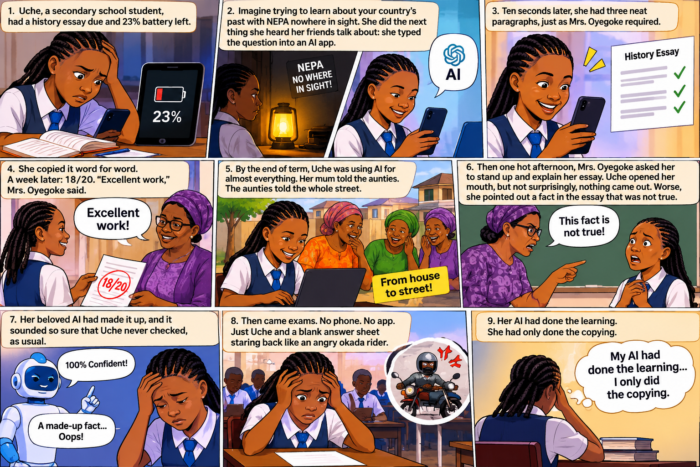
Now, let’s meet Uche.
Where It Goes Wrong
Uche’s story shows the real risks of using AI carelessly:
1. You skip the learning: if AI does the thinking, your brain does not build the skill.
2. AI can be confidently wrong: it sometimes invents facts, names and figures. If only Uche had learned to cross check with textbooks.
3. You become dependent: exams, interviews and real life experiences would not come with an app.
All of this raises the question:
What Is Obtainable Now?
As Techeconomy noted in August 2025, the National AI Strategy is still in the works and is yet to shape what happens in our classrooms. What we are currently doing in Nigeria is teaching AI. According to Techpoint Africa, the Experience AI programme trained 1,142 public secondary school teachers in its first year and is expanding in 2026.
That’s progress. But teaching AI without teaching students how to think about AI is like handing someone car keys without driving lessons. And with so few public schools even having computers, many students are left figuring it out alone on their phones.
What Uche’s Teacher Did Right?
The good news? Used well, AI works. The same Ecllipse brief reports that in a 2024 World Bank-supported pilot in Edo State, students using AI tools with teacher guidance gained nearly two years’ worth of literacy progress in just six weeks, and girls improved the fastest.
The difference was guidance.
Mrs. Oyegoke didn’t ban AI. She showed her how to use it:
She told her: “Ask it to explain, not to answer; for example, explain amalgamation like I’m 5, check everything, especially facts, write in your own words, and practice by asking it to quiz you before a test or an exam.
The next term, Uche’s grades dipped slightly. But this time, she could defend every single word.
TSDI’s Stand
All of this is why we talk about digital literacy, not just digital access. Opening an AI app is easy. Knowing when to trust it, when to question it, and when to put it down and think for yourself is the skill that lasts.
So here’s our question for every student, parent and teacher: “Is AI helping you learn, or is it doing all the work?”
References
– Ecllipse via TechCabal Insights, Strengthening Nigeria’s AI Literacy Drive (May 2025)
– Techeconomy, From Users to Creators (August 2025)
– Techpoint Africa, Experience AI 2026 Rollout


